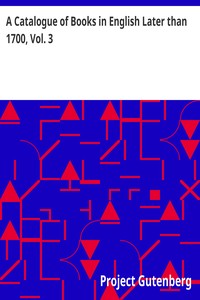
A Catalogue of Books in English Later than 1700, Vol. 3 by Shipman and Hoe
Let's be clear from the start: this is not a story in the traditional sense. You won't find heroes, villains, or a plot twist on page 47. 'A Catalogue of Books in English Later than 1700, Vol. 3 by Shipman and Hoe' is exactly what the title promises—a meticulous, centuries-old list. It documents thousands of books printed after 1700, organized by author, title, publisher, and sometimes physical details. It reads like the inventory of a giant, imaginary library.
The Story
The 'plot' is the catalog itself. You turn the page and find an entry for a 1782 book on bee-keeping. The next page lists a three-volume novel from 1823 that no one has heard of since. It's a parade of the ordinary and the obscure. But the real narrative hides in the margins. The compiler, listed only as 'Unknown,' made choices. Why include *this* obscure religious pamphlet but not *that* popular novel? The introduction, if a copy has one, might hint at a purpose—perhaps for booksellers, or a private collector's pride. The mystery of 'Shipman and Hoe' (the names on the title page) versus 'Unknown' (the listed author) hangs over every entry. It’s a ghost in the machine, a silent curator guiding you through a literary graveyard.
Why You Should Read It
You read this for the atmosphere and the questions it plants in your head. It’s a quiet, meditative experience. Each entry is a tiny window into the past—what people were reading, printing, and presumably caring about. You start imagining the lives behind the titles: the hopeful novelist, the earnest scientist, the fiery preacher. The anonymity of the author adds a layer of intrigue. It feels like handling a document from a secret society. This book turns you into a detective, piecing together a history of taste and knowledge from fragments. It’s less about reading and more about listening to the whispers of history.
Final Verdict
This is a super niche read, but utterly captivating if it's your thing. It's perfect for history buffs, bibliophiles, writers seeking obscure period details, or anyone who finds beauty in organized data and quiet mystery. It's not for someone looking for a thrilling narrative. But if you love the *idea* of books—their physical history, their lost stories, and the people who obsessively catalog them—then this strange, anonymous volume is a fascinating artifact. Think of it as a time capsule and a brain-teaser, all bound in one.
The copyright for this book has expired, making it public property. You can copy, modify, and distribute it freely.
Susan Martin
10 months agoWow.
Andrew Thompson
1 month agoThe formatting on this digital edition is flawless.
Thomas Walker
1 year agoJust what I was looking for.


Emma Allen
1 year agoEnjoyed every page.