
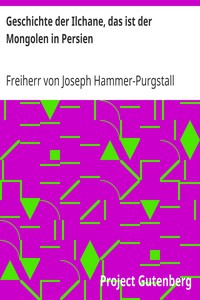
Geschichte der Ilchane, das ist der Mongolen in Persien by Hammer-Purgstall
Let's be clear: this isn't a light novel. Geschichte der Ilchane by Joseph von Hammer-Purgstall is a foundational 19th-century history text. But the story it tells is anything but dry.
The Story
It starts with Hulagu Khan's devastating invasion of Persia in the 1250s, which toppled the last Caliph. The book then follows his descendants, the Ilkhans, as they try to rule. The plot, so to speak, is their struggle to govern. They clash with other Mongol branches like the Golden Horde. They fight the Mamluks of Egypt. But the real drama is internal. Early Ilkhans flirted with Buddhism and Christianity, creating tension. Then, a pivotal Ilkhan named Ghazan converts to Islam, forcing the entire regime to change course. The rest of the narrative watches this Mongol elite slowly get absorbed by Persian administrative traditions and Islamic culture, all while dealing with constant revolts and family betrayals, until the dynasty sputters out in the 1330s.
Why You Should Read It
Hammer-Purgstall wrote this for scholars, but you can feel his fascination. He's showing us a grand experiment in power. What hooked me was watching these rulers, raised on the steppe, navigate the complexities of a settled empire. One minute they're issuing brutal decrees, the next they're patronizing gorgeous Persian art and science. The book paints a picture of a dynasty constantly adapting, often clumsily, to survive. It's a masterclass in how conquest is easy, but building something lasting is incredibly hard. You see the birth pangs of a new Persian-Islamic political order, forged under very unexpected rulers.
Final Verdict
This is a specialist's book, but it has crossover appeal. It's perfect for history buffs who already know the basics of the Mongol Empire and want to dive into one of its most fascinating chapters. It's also great for anyone interested in the messy, non-linear process of cultural change. If you enjoy books about empires in transition or the clash of civilizations, the raw material here is phenomenal. Just be ready for an academic writing style—it's a journey, not a quick read. Think of it as a primary source that opens a direct window into how 19th-century historians understood this pivotal era.
This masterpiece is free from copyright limitations. Distribute this work to help spread literacy.
Anthony Clark
11 months agoHelped me clear up some confusion on the topic.
Liam Torres
10 months agoA must-have for anyone studying this subject.
Jennifer Hernandez
1 year agoCompatible with my e-reader, thanks.
Mason Flores
7 months agoVery interesting perspective.


Lisa Miller
7 months agoI had low expectations initially, however the narrative structure is incredibly compelling. Definitely a 5-star read.