
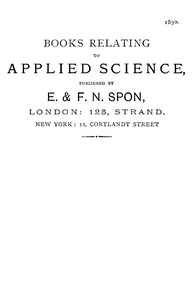
Books Relating to Applied Science, Published by E. & F. N. Spon, 1890.
Let's be clear from the start: this is not a storybook. "Books Relating to Applied Science" is a publisher's catalog from 1890. Imagine flipping through a very old, very specialized textbook warehouse list. That's this book. It was created by E. & F. N. Spon, a major publisher of technical manuals in London, to show potential customers exactly what they had for sale.
The Story
There's no traditional plot. Instead, the 'narrative' is told through hundreds of book titles and descriptions. You'll find sections on everything from civil engineering and architecture to metallurgy, telegraphy, and sanitation. One page lists manuals for building railways; the next details books on dyeing fabrics or brewing beer. It's a snapshot of a world in the middle of an industrial revolution, obsessed with how things work and how to make them work better. The 'characters' are the forgotten authors and the intended readers—the practical men (and they were almost all men) shaping the physical world.
Why You Should Read It
You read this for the atmosphere and the details. It's a direct line to the concerns of 1890. The sheer volume of books on things like 'gas lighting' or 'steam engine maintenance' tells you what industries were booming. You see the birth of modern specializations. It's oddly grounding to see that people were just as worried about proper drainage, strong materials, and efficient machines as we are today—they just had different tools. Browsing it feels like exploring a museum archive; you're not following a story, you're piecing together a world.
Final Verdict
This is a niche read, but a rewarding one. It's perfect for history buffs, especially those interested in the Industrial Revolution, technology, or Victorian society. It's also great for writers or world-builders looking for authentic period detail. If you love old maps, blueprints, or primary sources, you'll enjoy this. However, if you're looking for a narrative or character-driven book, this isn't it. Think of it as a reference book that's also a historical artifact—a quiet, fascinating look at the literal building blocks of the past.
This title is part of the public domain archive. Knowledge should be free and accessible.
Steven Torres
1 year agoThis is one of those stories where the atmosphere created is totally immersive. I will read more from this author.
Deborah Williams
2 weeks agoHigh quality edition, very readable.
Sarah King
9 months agoAfter hearing about this author multiple times, the flow of the text seems very fluid. Truly inspiring.