
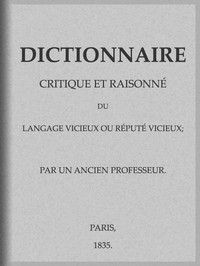
Dictionnaire critique et raisonné du langage vicieux ou réputé vicieux by Platt
Let's be clear: Dictionnaire critique et raisonné du langage vicieux ou réputé vicieux is not a novel. There's no hero's journey. Instead, the 'story' is the authors' mission. Think of Platt and de Cancarnaux as two language detectives, patrolling the streets of 19th-century French speech and writing. Their goal? To hunt down and expose what they called 'vicious' language—any word, phrase, or pronunciation they deemed incorrect, vulgar, or a corruption of pure French.
The Story
The book is structured as a series of entries, from A to Z. For each word or phrase they target, they don't just give a definition. They launch into a mini-essay. They explain why they think it's wrong, often tracing its origins to show it's an imposter or a decayed form of something better. They rant about slang creeping in from the workshops, complain about fancy people using words incorrectly to sound smart, and lament the loss of older, 'purer' forms. The drama comes from their absolute conviction. This is a battle for the soul of the French language, and they see themselves as its last defenders against a tide of bad habits.
Why You Should Read It
You should read it because it’s a fascinating window into how people think about language and rules. It's easy to laugh at their stuffy opinions (and you will), but it also makes you think. Who decides what's 'correct'? Is language a fixed museum piece to be protected, or a living thing that changes with its speakers? Seeing their frustration with the language of their own time is a mirror to our own endless debates about texting slang, new pronouns, or changing grammar rules. It turns a book about 'errors' into a deep, if unintentional, conversation about power, class, and identity.
Final Verdict
This is a niche book, but a brilliant one for the right reader. It's perfect for word nerds, language lovers, and anyone who's ever gotten into an argument about grammar. History buffs will get a kick out of the 19th-century social attitudes baked into every complaint. It’s not a page-turner in the usual sense, but if you enjoy ideas and social history, it's a captivating and often very funny time capsule. Just be prepared for some seriously strong opinions about prepositions.
There are no legal restrictions on this material. Distribute this work to help spread literacy.
John Hill
10 months agoGood quality content.
Donald Lopez
7 months agoI didn't expect much, but the narrative structure is incredibly compelling. Thanks for sharing this review.
James Lopez
8 months agoEssential reading for students of this field.
Jessica Lopez
7 months agoI have to admit, it provides a comprehensive overview perfect for everyone. Worth every second.



Joshua Davis
4 months agoAmazing book.