
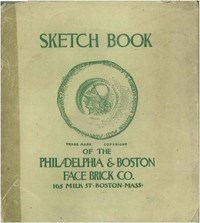
Sketchbook of the Philadelphia & Boston Face Brick Co.
Let's be clear from the start: this isn't a book with a plot in the traditional sense. There are no characters, no dialogue, no rising action. Instead, 'Sketchbook of the Philadelphia & Boston Face Brick Co.' is a direct window into the practical world of 19th-century American construction. It's a reproduced collection of technical drawings, page after page of meticulously rendered brickwork designs.
The Story
The 'story' is told in lines of ink and careful shading. Each page presents a different architectural detail: how to lay bricks to create a decorative pattern for a facade, the design for a curved window arch, or the intricate corbeling for a cornice. This was the catalog, the idea book, for builders. It shows the hidden language of the cityscape, the considered choices that gave even utilitarian buildings a touch of dignity and design. The narrative arc is the silent ambition of an industrializing nation, building its identity literally from the ground up, brick by standardized brick.
Why You Should Read It
I picked this up out of sheer curiosity and ended up completely absorbed. In our age of glass and steel, it's easy to forget the artistry in something as simple as brick. This sketchbook reawakens that. There's a profound respect for material and pattern on every page. It makes you look at your own city differently. You start noticing the zigzag pattern in an old factory wall, the subtle curve over a corner store's doorway. The anonymous artist (or artists) who made these drawings invested incredible care into what many would see as mere construction details. It’s a quiet, powerful reminder of the pride embedded in everyday work, and a fascinating piece of social history disguised as a trade catalog.
Final Verdict
This is a niche gem, but a brilliant one. It's perfect for urban explorers, history nerds who love the 'how' of everyday life, architects, and anyone with an appreciation for industrial design or folk art. It's not a page-turner; it's a book to sip slowly, to use as a reference for your own city walks, or to simply marvel at the precision of a bygone craft. If you've ever looked at an old building and wondered, 'How did they do that?'—this book has your answers.
This is a copyright-free edition. Knowledge should be free and accessible.






Dorothy Harris
1 year agoClear and concise.