
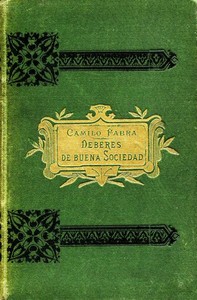
Deberes de buena sociedad by Camilo Fabra
First published in 1894, Deberes de buena sociedad is exactly what its title promises: a manual on the duties of good society. Written by Camilo Fabra, a prominent Catalan industrialist and politician, this book isn't a story with characters and plot twists. Instead, it's a direct window into the social codes and expectations of Spain's upper classes at the end of the 19th century.
The Story
There's no traditional narrative here. Think of it as a guidebook. Fabra systematically outlines the rules for proper conduct in nearly every aspect of public and private life for a gentleman and lady of standing. He covers personal presentation, from the correct wardrobe for morning visits versus evening soirées. He details the etiquette of correspondence, visits, and conversations. Entire sections are devoted to running a household, managing servants, and hosting events like dinners and balls. The book operates as a blueprint for maintaining social status, emphasizing honor, discretion, and a strict adherence to form. The 'story' is the portrait it paints of a society where every action, from a handshake to the placement of a calling card, was loaded with meaning.
Why You Should Read It
This book is a social historian's dream, but it's also genuinely engaging for any curious reader. What I found most compelling was seeing the anxiety beneath all the rules. This isn't just about politeness; it's about control. In a time of great social and industrial change, this manual was a way to define and defend the boundaries of an elite class. Reading it, you get a real sense of what they were trying to protect. Some rules are charmingly archaic, others feel stifling, and a few are just bizarre to our modern eyes. It makes you think about our own unwritten social rules today. Fabra writes with absolute certainty, which makes the whole thing a fascinating study in authority and the construction of 'good taste.'
Final Verdict
This isn't a book you read for a thrilling plot. It's for the intellectually curious. It's perfect for history buffs, writers researching the Victorian/19th-century era, or anyone fascinated by the anthropology of everyday life. If you've ever enjoyed shows like 'Downton Abbey' and wondered about the real rulebooks behind the manners, this is your primary source. It's also a great pick for anyone interested in how societies define class and respectability. Approach it like a museum visit—you're there to observe, analyze, and sometimes smile at the intricate formality of a world long gone.
The copyright for this book has expired, making it public property. Knowledge should be free and accessible.
Deborah Wright
1 year agoFive stars!
Richard Harris
1 month agoTo be perfectly clear, the narrative structure is incredibly compelling. I will read more from this author.
Thomas Wright
1 year agoEssential reading for students of this field.
Anthony Walker
3 months agoAfter hearing about this author multiple times, it challenges the reader's perspective in an intellectual way. I learned so much from this.





Christopher Walker
1 month agoA must-have for anyone studying this subject.