
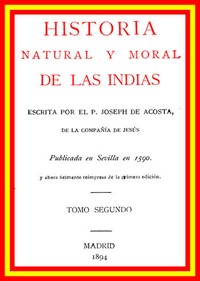
Historia natural y moral de las Indias (vol. 2 of 2) by José de Acosta
José de Acosta's Historia natural y moral de las Indias isn't a novel with a plot, but it has a powerful story at its heart. It's the story of a European mind encountering a reality it was completely unprepared for. Published in 1590, this is Acosta's attempt to compile everything he learned during nearly two decades in the Spanish colonies. He structures it like a massive report, divided into two parts: 'Natural History' (the physical world) and 'Moral History' (the people and their cultures).
The Story
Acosta starts with the land itself. He describes the shocking geography—the endless cordilleras of the Andes, the vastness of the Amazon, the terrifying power of earthquakes and volcanoes. He catalogs plants and animals that defied European categories: potatoes, tomatoes, llamas, hummingbirds. Then, he turns to the people. He documents the complex societies of the Inca and Aztec empires, their governments, religions, and histories. He's trying to fit these new worlds into the old frameworks of European knowledge, and you can feel him struggling. How did these people get here? Why are their animals so different? His answers are sometimes brilliant guesses (like theorizing a land connection to Asia) and sometimes limited by his era's beliefs.
Why You Should Read It
You should read this because it's raw, unfiltered history. This isn't a polished retrospective written centuries later. It's the live reaction of a sharp, observant, and deeply religious man trying to process an overwhelming amount of new information. His respect for indigenous engineering and statecraft often shines through, even as he condemns their religion. You see the birth of anthropology and ethnography, messy and biased as it is. Reading Acosta feels like sitting with a time traveler who is desperately trying to explain the most incredible journey of his life, grasping for the right words to describe things his audience has never even dreamed of.
Final Verdict
This book is perfect for history buffs who want to move beyond dates and battles and get inside the head of the past. It's also great for anyone interested in the history of science, ideas, or cultural encounters. Be warned: it's a primary source from the colonial period, so it contains the prejudices and assumptions of its time. But that's precisely what makes it so valuable. It doesn't give you easy answers; it shows you how hard the questions were. If you're looking for a thrilling, personal, and mind-expanding window into the moment the world truly became global, Acosta's 'History' is an unforgettable read.
No rights are reserved for this publication. Distribute this work to help spread literacy.
Logan Wright
1 year agoI came across this while browsing and the narrative structure is incredibly compelling. Truly inspiring.

Sarah Hill
1 year agoThe index links actually work, which is rare!