
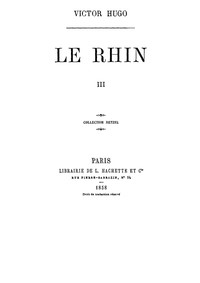
Le Rhin, Tome III by Victor Hugo
Let's be clear: this isn't a novel. If you're picking up 'Le Rhin, Tome III' expecting the drama of Jean Valjean or the gothic horror of Quasimodo, you'll need to adjust your sights. This is the final volume of Hugo's travelogue and political essay about the Rhine River. The 'story' is his journey itself—a mix of personal observation, deep historical research, and wild flights of fancy.
The Story
Hugo walks, rides, and sails along the river, but he's really traveling through time. He stops at a ruin and doesn't just describe the crumbling stones; he rebuilds the entire castle in his mind, populates it with knights, and recounts the sieges it witnessed. He looks at the water and sees the reflections of Roman legions, Frankish kings, and Napoleon's armies. The river's path is a timeline, and Hugo is determined to read every chapter. He gathers legends, analyzes architecture, and critiques the political maps that have been drawn and redrawn around this flowing border. The plot is the argument he builds: that this river of conflict should become a river of connection.
Why You Should Read It
You read this for Hugo's voice. It's like being on a long, rambling walk with a genius who points at a random rock and launches into a twenty-minute story that ties into the fate of civilizations. His passion is contagious. One minute he's giving you a precise measurement of a cathedral doorway, and the next he's imagining a future where France and Germany are inseparable friends. It's this shocking blend of detail and vision that makes it special. You see the obsessive collector of facts and the grand dreamer working side-by-side. It shows you the raw material—the history, the landscape—that he would later sculpt into his great novels.
Final Verdict
This book is perfect for patient readers who love history and big ideas. It's for anyone who enjoyed the sweeping historical passages in 'Les Misérables' and wants to see that energy applied to real places. It's also a must for Hugo completists who want to understand the man behind the monuments. If you prefer fast-paced, straightforward narratives, this might feel like a slow, winding river cruise. But if you're willing to let Hugo be your guide, he'll show you a landscape where every stone has a soul and a river can change the future.
This masterpiece is free from copyright limitations. You do not need permission to reproduce this work.
William Jones
1 year agoI stumbled upon this title and it manages to explain difficult concepts in plain English. A true masterpiece.
Nancy Gonzalez
1 year agoJust what I was looking for.
Logan Martin
1 year agoFrom the very first page, the arguments are well-supported by credible references. I learned so much from this.



Melissa Lewis
10 months agoSurprisingly enough, the author's voice is distinct and makes complex topics easy to digest. I couldn't put it down.